The History of the Phonograph: From Edison's Tinfoil Cylinder to the Vinyl Revival
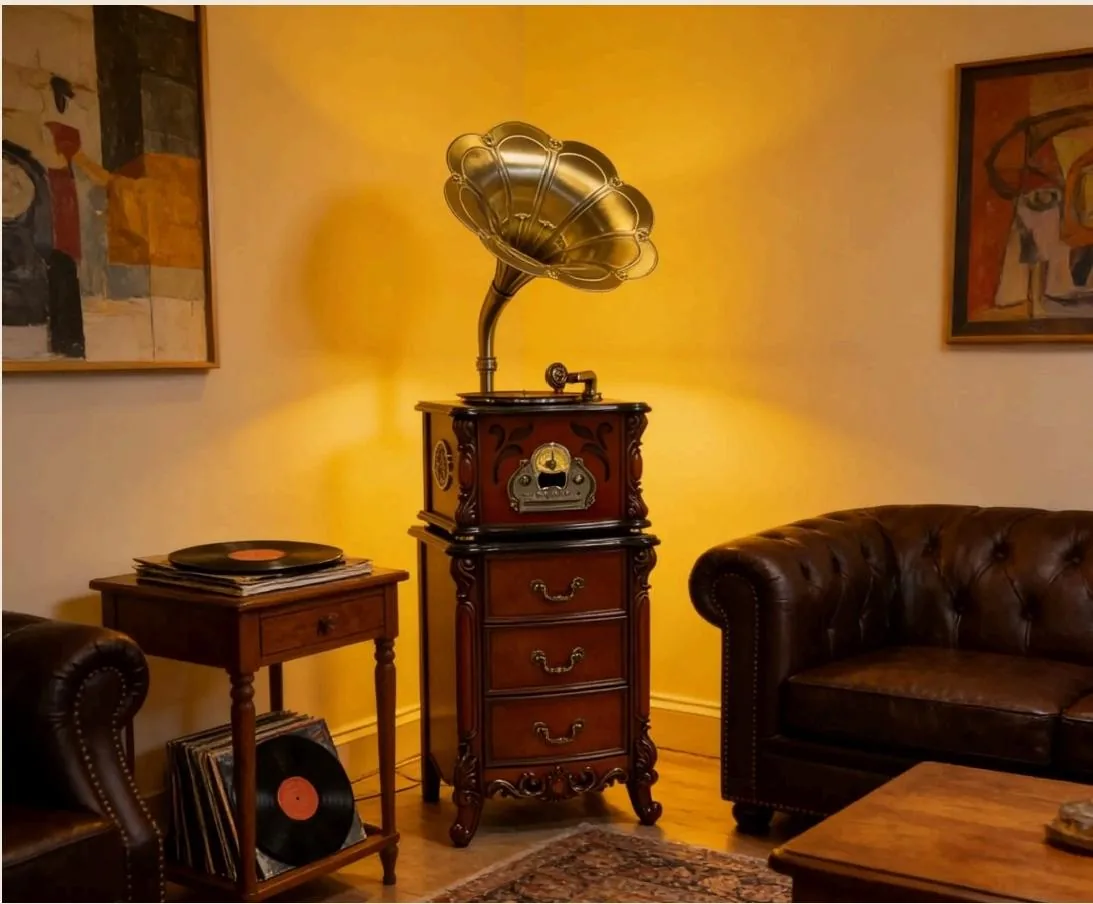
The phonograph was the first machine that could both record and reproduce sound. When Edison captured the human voice on a tinfoil cylinder in 1877, it changed the relationship between people and music forever. Yet for today's buyers the phonograph is no longer just a museum exhibit — it has become a substantial home and commercial category: 'vintage audio furniture' that pairs traditional craftsmanship with modern electronics. This article walks through its evolution so you understand the category you are sourcing and the story your customers want to tell.
1. A 150-year timeline at a glance
The history of recorded sound is short, but it moves fast. These are the milestones that shaped the machines we now call phonographs and gramophones.
- 1857 — Scott's phonautograph. Frenchman Léon Scott drew sound waves onto soot-blackened paper. His machine could record sound but not play it back — the first step toward capturing audio, yet still unable to reproduce it.
- 1877 — Edison's phonograph: sound is held. Edison patented the phonograph, wrapping a cylinder in tinfoil while a stylus cut grooves as the cylinder turned. The first recording is said to be 'Mary Had a Little Lamb'. The grooves were vertical (hill-and-dale), and each tinfoil cylinder wore out after only a few plays.
- 1887–88 — The wax era: Bell's Graphophone and Edison's improvements. Bell's team replaced tinfoil with wax cylinders (graphophone), which were quieter and reusable; Edison followed with an all-wax, motor-driven cylinder for stable playback. The cylinder stayed the premium format for decades.
- 1887–93 — Berliner's gramophone: the flat disc wins. Emile Berliner's gramophone played flat discs coated in wax with lateral (side-to-side) grooves. The breakthrough was that records could be stamped from a master and mass-produced. Shellac records appeared in 1891, and production scaled up around 1893 — the true birth of the record industry.
- 1901–06 — Victor and the Victrola: sound becomes furniture. Eldridge Johnson founded the Victor Talking Machine Company in 1901, and in 1906 launched the Victrola, which hid the horn inside a wooden cabinet with doors that doubled as a volume control. The phonograph moved from a laboratory curiosity to the centre of the living room.
- 1925 — The electric era. Electronic amplification and microphone recording replaced purely mechanical pickup, making records louder, cleaner and more faithful, and laying the foundation of the modern audio chain.
- 1948–49 — LP and EP: long-playing records arrive. Columbia's Peter Goldmark introduced the 12-inch vinyl LP (33⅓ RPM, roughly 30 minutes per side), and RCA answered with the 45 RPM EP. Vinyl replaced shellac and defined a generation of home listening.
- 1958 to today — Tape, CD, streaming and the vinyl revival. Reel-to-reel tape, cassettes, CDs and MP3 were each declared the record's successor, and none succeeded in killing it. From the 2000s onward vinyl returned as a collectible, a ritual and a design object — which is exactly why the phonograph is selling again as 'furniture' rather than 'player'.
2. Phonograph, gramophone, Victrola or turntable?
Four terms describe the machines on this timeline, and each refers to a specific format. Knowing the difference helps you match your terminology to what your customers are searching for.
- Phonograph — cylinder records, vertical grooves, Edison's 1877 machine; today the word is used loosely for any vintage record player.
- Gramophone — flat discs, lateral grooves, Berliner's 1887 machine; the format that made records mass-producible.
- Victrola — flat discs, lateral grooves, Victor's 1906 brand with the horn hidden in a cabinet; it became shorthand for a quality home machine.
- Turntable — flat discs, lateral grooves, the modern component (platter, tonearm and cartridge), usually with electronic amplification.
Each name also carries its own selling point: the phonograph sells the story, the gramophone sells the brass-horn silhouette, and the Victrola sells the furniture piece. A complete range covers all four.
3. Why the phonograph is coming back — and what it means for buyers
The revival of vinyl brought the machine back with it, and the demand is not just nostalgic. Three buying patterns explain why the category is growing.
- A home that says something. Buyers across Europe, North America, the Middle East and Southeast Asia want objects that show taste. A standing brass-horn phonograph reads as handmade and deliberately chosen — furniture that starts a conversation.
- Hospitality and project procurement. Hotels, clubs and cafés specify vintage acoustic pieces for lobbies and lounge areas. Add an electric fireplace and the unit becomes a complete ambience centre — which is why 'phonograph plus fireplace' is a standing project line.
- Gifting and collectibles. Models with shell inlay and gold detailing are positioned as premium gifts, carrying a higher ticket price and better margin than ordinary audio equipment.
4. Common buyer misconceptions
A few misconceptions come up again and again from buyers new to the category. Here is what is actually true.
- 'It only plays old shellac.' Modern models use a modern mechanism and integrated electronics, and support 33/45/78 RPM vinyl — usually with CD, USB, Bluetooth and FM radio as well.
- 'Vintage look means poor sound.' The retro exterior is a deliberate design choice; the audio path uses a modern cartridge and amplifier, delivering a vintage look with steady output.
- 'Customization means a huge MOQ.' Stock models are available from a single sample unit, while branded and custom-spec orders start from 50 units — colour, material, power, functions and logo can all be adjusted.
- 'It is an antique and can't be mass-produced.' These are newly manufactured goods. The factory controls woodworking, painting and electronics in-house, and supplies retail, gifting and even 200-room hotel projects.
As an OEM/ODM supplier, we provide export documentation and destination-country compliance support on a per-order basis; the specific certifications required depend on the importing country's regulations and the final order confirmation.
5. Four lines of vintage audio furniture
The range is organised into four lines: upright antique-style cabinets, phonograph-plus-fireplace consoles, classic new-Chinese pieces, and modern tabletop vinyl players. Full specifications, finishes and MOQs are listed on each category page.
However you enter the category — a retail range, a gifting program or a hotel project — the history explains the demand: people buy the story and the look as much as the sound. If you would like to build a program around it, get in touch and we will point you to the models that match your market and budget.