Inside the Workshop: How a Cabinet Phonograph Is Built
A cabinet phonograph looks simple enough: a wooden box, a platter, a horn. In reality it is half furniture and half instrument, and whether a unit delights or disappoints a buyer is decided long before it reaches the showroom. Here is how one is actually built — and what 'done properly' looks like at each stage.
1. From raw board to record player
Manufacturing runs through six stages: wood preparation, cabinet construction, finishing, the audio heart, assembly and QC, then export packing. Every step quietly shapes the experience the end buyer will have years later. Skipping a stage to save a day almost always costs more downstream — in returns, in reputation, and in a machine that does not belong in the room it was bought for.
- 1 — Wood selection and seasoning.
- 2 — Cabinet construction and joinery.
- 3 — Finish, hardware and detailing.
- 4 — The audio heart: turntable, tonearm, amplifier, speakers.
- 5 — Assembly and quality control.
- 6 — Export packing for long-distance freight.
2. Step 1 — Wood selection and seasoning
Everything starts with the material. The cabinet is both the enclosure and the face of the product, so the wood has to do two jobs at once: stay dimensionally stable through humidity swings, and look good doing it.
- Species and cutting. Different woods read differently — warm mahogany, cooler walnut, lighter oak — and how grain is matched from panel to panel decides whether the cabinet looks crafted or assembled from leftovers.
- Seasoning. Properly dried and rested timber resists warping and cracking. Rushing this step is the invisible source of gaps, rattles and finish cracks a year later.
- Why buyers should care. Stable wood protects durability and appearance together — the two things an owner or venue lives with long after the novelty wears off.
3. Step 2 — Cabinet construction and joinery
The cabinet is designed around two requirements: it must behave like furniture, and it must not add resonance or noise of its own to the sound.
- Joinery. Dovetail or reinforced mitre corners keep the box square through years of opening lids and being moved.
- Acoustic cavity. The internal chamber around the speakers is shaped and braced so the cabinet supports the sound rather than fights it.
- Fit and alignment. Lids, hinges and access panels sit flush — details a guest cannot name but can always see.
4. Step 3 — Finish and detailing
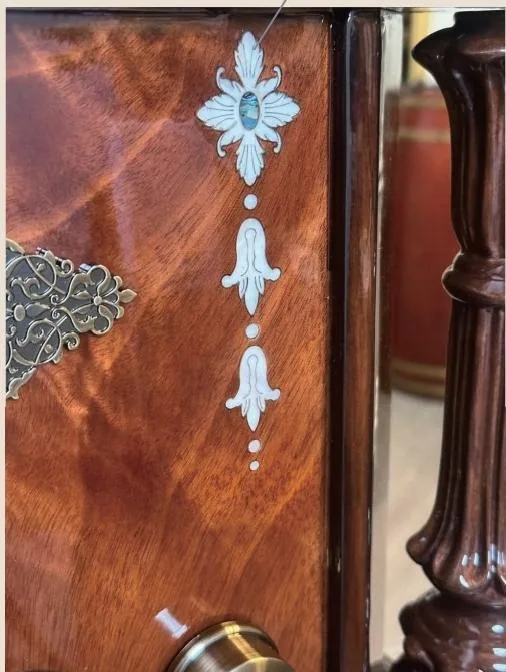
This is where a cabinet becomes a piece. Stain, lacquer, hardware and grille cloth turn raw timber into the finished object the buyer pictures in their room.
- Stain and topcoat. Multiple layers build depth and protect the surface; the right sheen matches the venue's interior rather than a catalogue default.
- Hardware and grille cloth. Hinges, feet, knobs and speaker cloth are the small parts that read as quality or as cheap up close.
- Badges and branding. The point where your brand lives — easy to align with private-label or a venue's own identity.
- Consistency. Matching colour and sheen across a batch is what makes a multi-unit fit-out look like one commission.
5. Step 4 — The audio heart
Behind the wood shell is the part that actually makes sound, assembled and adjusted with care because fidelity is settled here.
- Platter and motor. A platter that is truly round and spins at the correct speed is the foundation; steady speed keeps pitch in tune.
- Tonearm and cartridge. The arm tracks without skipping, and the cartridge turns movement into signal — the same chain described in our stylus guide.
- Amplifier and speakers. Built-in electronics shape the tone and drive the drivers; matching them to the cabinet's cavity is part of the craft.
6. Step 5 — Assembly and quality control
Putting a phonograph together is half the job; checking it is the other half. Thorough QC typically covers:
- Speed and stability — the platter reaches and holds the correct speed, with no wobble an audience could hear as pitch drift.
- Tracking — the tonearm runs the whole record without skipping or mistracking.
- Clean sound — low noise floor, no hum, balanced tone between amplifier and speakers.
- Build and wiring — internal connections secure, cabinet square, lids and hinges smooth.
- Finish — no defects in stain, sheen or hardware, and a match to the approved sample.
The purpose of QC is not a perfect bench demo. It is a machine that works on day one and keeps working for a real buyer, in a real room, under real use.
7. Step 6 — Packing for the long journey
A phonograph is heavy, wooden and often shipped across hemispheres. Export packing is worth paying for:
- Protection. Foam, corner protectors and double-wall corrugated board absorb the knocks of long-distance freight.
- Documents. Paperwork is prepared to the requirements of the destination market and confirmed with your order.
- Presentation. For private-label and venue orders, unboxing is part of the brand — packaging follows the brief rather than a generic default.
8. Why buyers should care
For a hotel fit-out, a collector's piece or a café centrepiece, manufacturing quality is the line between becoming part of the story and becoming a return. Knowing the steps lets you ask suppliers the right questions — about timber, about QC, about how samples are compared against mass production — instead of judging from photographs alone.
9. Frequently asked questions
Three questions come up most often once buyers start looking at how these cabinets are made:
- Q: Why does the wood matter so much in a cabinet phonograph? A: Properly seasoned timber stays stable through humidity changes, so seams do not open and lacquer does not crack. Grain matching and stain decide whether a unit looks bespoke or generic — good wood selection protects durability and appearance at the same time.
- Q: What does phonograph QC actually check? A: Beyond appearance, it usually covers a platter that is round and running at the right speed, a tonearm that tracks without skipping, clean amplifier output with no noise, secure internal wiring and defect-free finish. The goal is a machine that works on day one and keeps working in a real room, not just on a bench.
- Q: Can manufacturing adapt to my brand or market? A: Yes. Wood species, stain, hardware, grille cloth, badges and packaging are standard customization points, and the audio configuration can be matched to the records your listeners are likely to play. Share your direction early so manufacturing and the brief align from the first sample.
If you want to see the manufacturing behind your order, send us your brief — wood direction, finish, audio requirements and volume — and we will walk you from sample to shipment with QC you can point to.